Workplace safety isn’t just an HR issue; It is a legal and moral duty. When negligence leads to death, the conversation shifts from compliance to crime, and that shift is recurring more often than we realize.
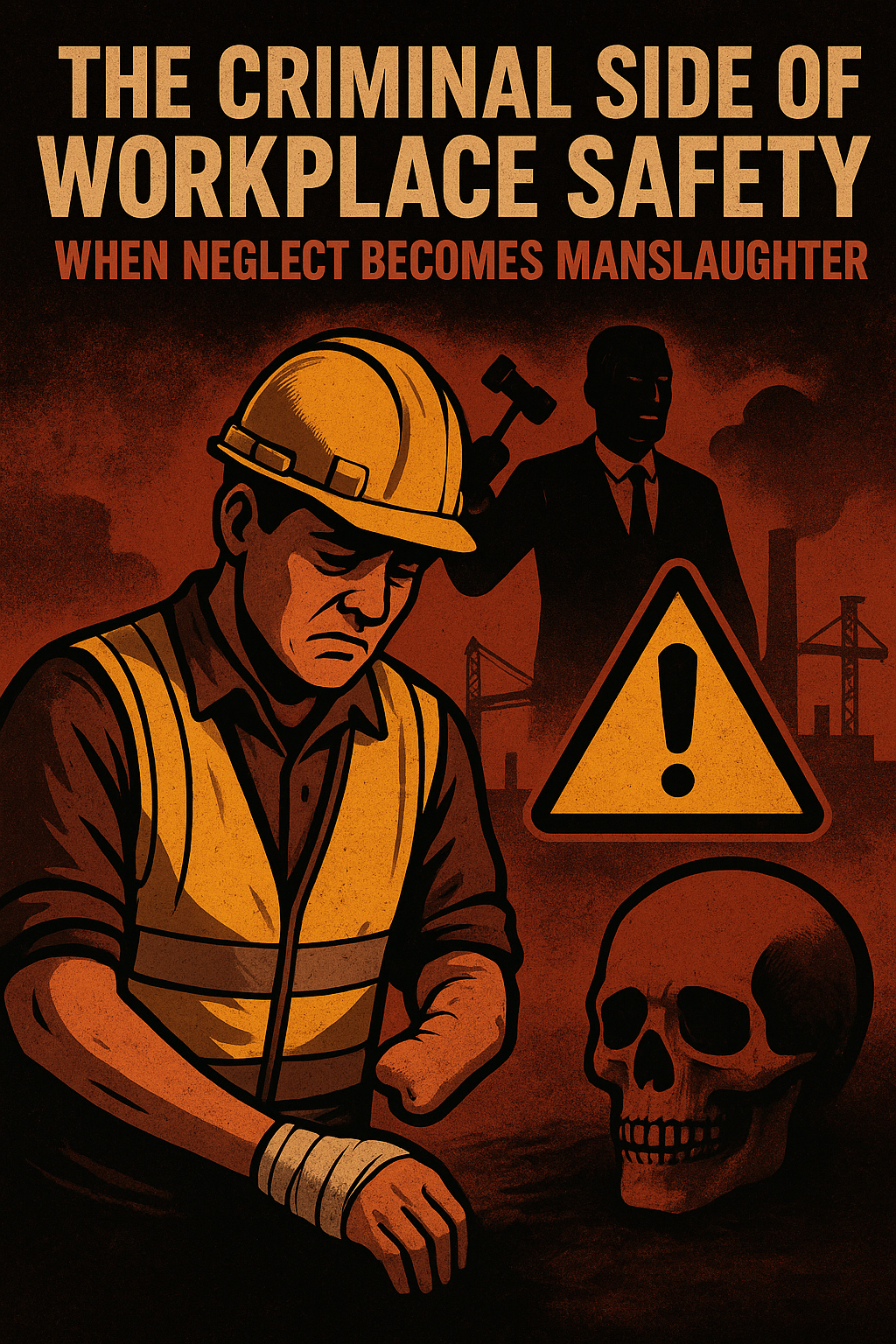
In 2008, a former employee of the defunct Power Holding Company of Nigeria (PHCN) suffered a tragic accident while carrying out repair work. Despite notifying the station of the ongoing maintenance, electricity was suddenly restored, resulting sadly in the loss of both his arms. Reports later showed that staff had complained several times about faulty wiring, but management dismissed it as “minor.” That one decision to ignore a safety warning cost a man his arms. In most cases, lives are taken. And under the law, that’s not just negligence. It’s a criminal act.
The Numbers Present a Sobering Reality
A.O. Ezema’s study on occupational injuries in Nigerian factories revealed 3,183 reported cases between 1987 and 1996, with 71 fatalities and a 2.23% fatality rate.
Major causes included machinery accidents (16.9%), explosions (14.1%), and falls (12.6%). The coal-petroleum, wood, and non-metallic manufacturing industries recorded the highest death rates.
The data on workplace accidents in Nigeria’s construction industry is alarming. Between 2014 and 2019, the sector accounted for over 39% of all fatal workplace incidents.
A survey by the Bureau of Labor Statistics (BLS) in 2023 found that a major cause of these accidents is the lack of training and experience. Construction had the most fatalities (1,075) among all industry sectors in 2023, and was the highest for the sector going back to 2011. Falls, slips, and trips accounted for 39.2 percent (421) of all construction fatalities, with transportation incidents accounting for another 22.3 percent (240) of fatalities.
Over the course of eleven years, analysis also revealed that 40% of construction accidents were attributed to unsafe practices by untrained or poorly supervised workers. In an article by Skillcast,The Health and Safety Executive (HSE) adds that weak supervision, poor enforcement of safety rules, and a lack of awareness continue to drive these preventable deaths.
These aren’t just statistics; they represent lives lost, families broken, and communities mourning deaths that never should have happened. Many of these “accidents” were the result of choices that led to decisions to cut corners, ignore warnings, or prioritize cost over safety.
The Cost of This Neglect
Many employers still see safety rules as optional. They carry on their daily activities without protective gear. But under Nigeria’s Factories Act and Labour Act, every employer is legally required to provide a safe working environment and protective equipment. Ignoring these obligations, especially after repeated warnings, crosses the line from carelessness to criminal negligence.
According to Idem’s study “In Nigeria there is no law for the prosecution of corporations for crimes of workplace manslaughter by negligence. In recent years, the English legal system, along with other common law countries, has introduced laws addressing deaths that occur in the workplace.
Other countries take it even more seriously. The UK’s Corporate Manslaughter and Corporate Homicide Act (2007) and the U.S. OSHA laws hold companies accountable when safety neglect leads to death. The message is clear: workspace negligence can kill and those responsible must face justice.
The Price of Humanity
Behind every workplace fatality is a person who is a father, mother, or young worker who left home expecting a normal day. These deaths leave families grieving, children struggling, and colleagues fearful.
It is a failure of leadership when profit is placed above safety. And it’s even worse when the system treats preventable deaths as bad luck instead of manslaughter.
Accountability and Prevention
Safety should never be treated as a box to tick. Every investigation should ask: Was this truly an accident, or did someone choose to look away?
●Simple actions can save lives:
●Conduct regular safety checks.
●Train every worker properly.
●Encourage staff to report hazards without fear.
●Enforce real penalties for neglect.
The Bottom Line
Workplace safety is everyone’s responsibility. But when neglect causes death, it’s not an accident but a crime. Employers must understand that safety is not expensive; neglect is.
Until companies start seeing safety as a duty to protect lives, not just a formality, preventable deaths will continue. Furthermore, unless the law starts holding people accountable, justice will remain out of reach for too many families.
Nobody should die simply for trying to earn a living.
The time to act is Now!
Author: Amarachukwu Eze
Amara is a dedicated Virtual Assistant with a passion for helping brands stay organized and clients feel valued. With a background in Criminology and a strong eye for detail, she brings analytical insight and structure to every project she manages. Beyond her professional work, she volunteers with the Safety Awareness and Well-being Foundation, where she contributes to awareness and advocacy initiatives. Her writing reflects a blend of efficiency, empathy, and purpose. And empowering readers to build safer, smarter, and more sustainable systems in work and life.